
Breaking Down Hemingway's Famous Iceberg Theory
Understanding one of great methods of storytelling

If a writer of prose knows enough about what he is writing about, he may omit things things that he knows and the reader, if the writer is truly enough, while feel those things as strongly as if the writer had stated them. The dignity of the movement of the iceberg is due to one-eighth of it being above water
Ernest Hemingway - “Death in the Afternoon”
“The Iceberg theory” better known as the “theory of omission” was a key element of Ernest Hemingway’s writing style. Birthed from his days as a newspaper reporter for the Kansas City Star, Hemingway wrote in a minimalistic style. A type of writing where he learned that the details are often below the surface and would later shape novels like The Sun Also Rises and short stories such as The Hills Are Like White Elephants. So what is the meaning behind “Iceberg Theory”. and how should we apply it? Let's examine it closer!
What Is Iceberg Theory?
“Iceberg Theory” suggests that a writer should only explicitly include a small portion of the story's details, leaving the rest implied, much like the visible tip of an iceberg, allowing readers to actively engage and interpret deeper meaning. In short- Omit all the details. The unsaid is just as important as the said in this type of writing.
Hemingway as I quoted him above at the start of this article believed that the depth and meaning of a story lie beneath the surface. This is important because it leaves the reader to infer or interpret the writing for themselves. It makes for a more engaging writing experience for readers.
The iceberg is a symbol. After all, only one-eighth of the iceberg is visible above the surface. The remaining seven-eighths are hidden underwater and sailors often are unaware of the depth they float under. Here’s a diagram to further show this:
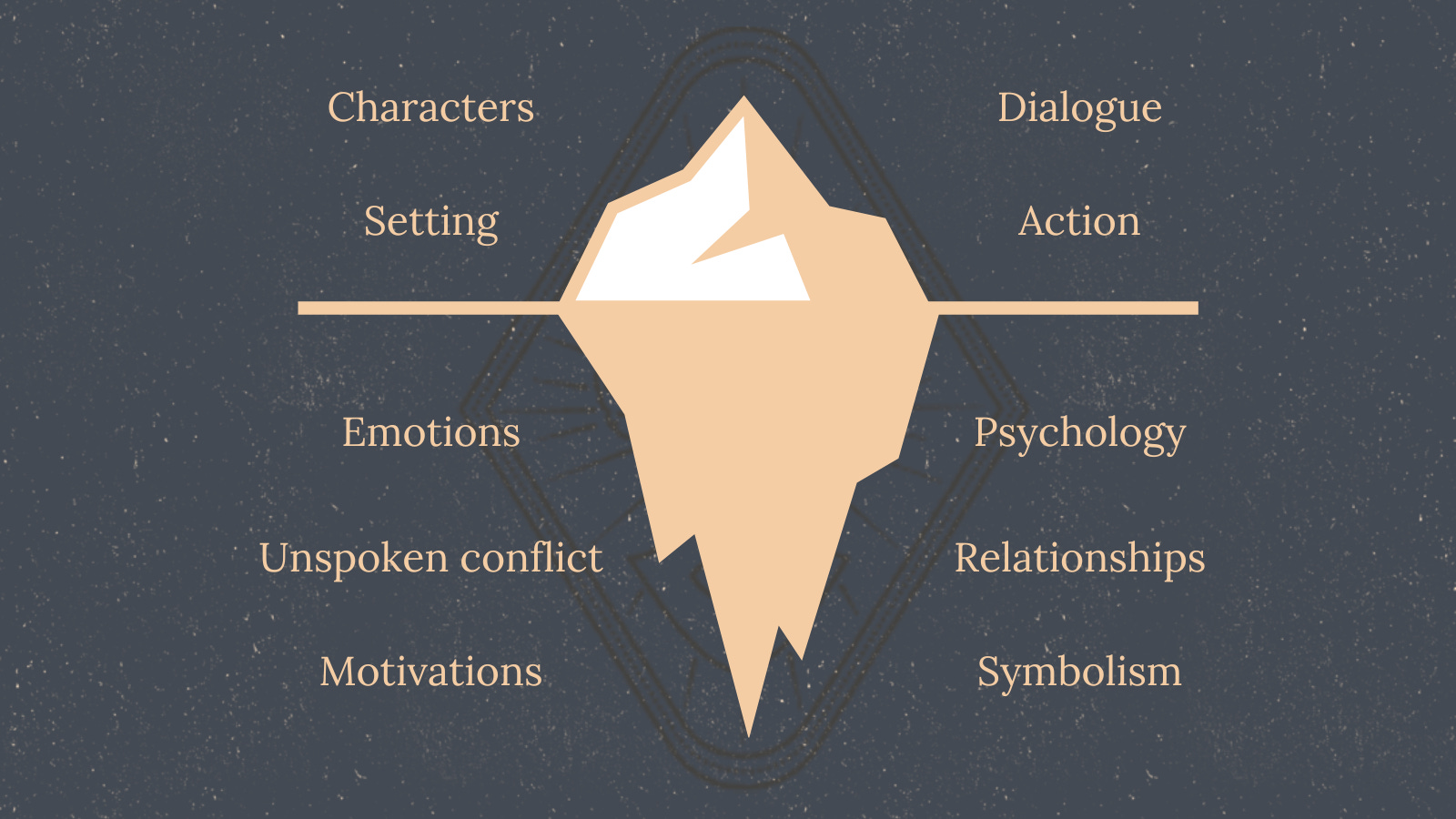
The above diagram shows how an author would approach the story while utilizing this theory. The writer in his first draft would write all of these elements into his story originally, only omitting things when they go to edit their story. Everything above the iceberg should be left in the story, while everything below the iceberg should be cut out.
How Should Writers Apply this?
There are four rules according to Hemingway on how to apply this theory to writing: Trust your reader, edit, know your backstory, and Write whats true.
In Trusting Your Reader, Hemingway was quoted saying “A writer must keep his mouth shut when a story is being told”. The message here is simply don’t preach. Lay out the story for the reader through the characters, the setting, and the action. Then writer's job is done.
On editing Hemingway’s days of writing looked something like this, “one page of masterpiece and 99 drafts of absolute shit”. Editing is a significant part of storytelling and something Hemingway was strict on. A Hemingway story is often very tight. His sentences are short and simple. They’re refined over and over again until he’s certain that everything is hidden underneath the iceberg so the bare minimum is left for the reader.
The above principle is where the backstory is crucial. The failed attempts at writing the story allow Hemingway to put it all down on the page. By unloading as much as he can, knowing it's not perfect, Hemingway is grasping every detail of his story and his characters. This gives him a proper understanding of the story parts in full, so that when he is refining it later he knows all the story parts.
The last rule is the most important to Hemingway, this is to write what is true. Writing is ultimately at its most powerful when it deals with the real complexities one faces in life. A writer should pull from events in their own lives to implement into their stories and pay attention to how those around them talk. This will allow them to use true phrases and events, which give them the knowledge and background to refine the story in a way that helps the reader understand what's underneath it all.
Examples where Hemingway Uses this Idea
Famously Hemingway’s “iceberg theory” is most commonly known from his short story The Hills Like White Elephants. In the story, the reader can deduce the unstated tension between the two characters over an unwanted pregnancy. The characters' dialogue hints at this tension but never once do they explicitly state the reason for such tension.
In his novels like A Farewell To Arms, he uses the war to express human endurance. This is shown through the character's experiences in World War I, without going into details of what makes these experiences so meaningful. Rather the reader is left to feel them through the actions of the novel and develop their own sense of the novel's themes.
To recap “The iceberg theory” is one of the most significant literary devices of storytelling ever created. The idea is about encouraging the reader to find their truths within the book, rather than the author lecturing them on the themes. This theory is an essential principle of storytelling. That has defined American writing ever since.